Showing posts with label east africa. Show all posts

Is Zenawi Running a Repressive Regime in Ethiopia? (1)

Lagos — Parts of southern Ethiopia resemble the scenery in a Tarzan movie. When I was there last fall, the green forested hills were blanketed in white mist and rain poured down on the small farms and homesteads. In the towns, slabs of meat hung in the butchers' shops and donkeys hauled huge sacks of coffee beans, Ethiopia's major export, along the stony dirt roads. So I was surprised to see the signs of hunger everywhere. There were babies with kwashiorkor, a disease caused by malnutrition, which I'd assumed occurred only in war zones. Many of the older children were clearly stunted and some women were so deficient in iodine they had goiters the size of cannonballs.

This East African nation, famous for its ancient rock-hewn churches, Solomonic emperors, and seemingly intractable poverty, has a long history of famine. But I had always assumed that food shortages were more common in the much drier north of the country than in the relatively fertile south. Although rainfall throughout Ethiopia had been erratic in 2008 and 2009, the stunting and goiter I saw were signs of chronic malnutrition, which had clearly existed for many years.

What was causing it? Ethiopia's long history of food crises is shrouded in myths and political intrigue. In 1984, famine killed hundreds of thousands of people and left millions destitute. At the time, the UN attributed the famine to drought. But most witnesses knew it had far more to do with a military campaign launched by Ethiopia's then-Soviet-backed dictator Mengistu Haile Mariam against a rebel group based in the northern province of Tigray, known as the Tigrayan People's Liberation Front (TPLF). Government forces isolated the peasantry, destroyed trade and markets, and diverted food aid to their own troops.


Read more

Battle for mogadishu


The U.S., European Union and their African allies are training and equipping the security forces of Somalia’s Transitional Federal Government to try to take back the parts of Mogadishu now under the control of an Al-Qaeda affiliate. Large portions of the city, known to most Americans as the site of the 1993 ambush that prompted the withdrawal of U.S. forces from the country, is controlled by the al-Shabaab terrorist group. Should Al-Qaeda and its allies succeed in seizing Somalia, they will be able to resurrect the network they lost in Afghanistan and activate their Somali networks in the West to deadly effect.
Recent incidents show the terrifying reach of al-Shabaab. An individual in Virginia named Anthony Joseph Tracy that admits having contact with the terrorist group is known to have smuggled 270 Somalis into the U.S., all of whom are believed to remain in the country and have proven extremely difficult to identify. It is improbable that al-Shabaab would use its resources to sneak random Somalis into the country. The odds are that these are their recruits and they are being used to establish sleeper cells in our midst. Considering that less than 20 terrorists were needed to execute 9/11, the number of nearly 300 could have catastrophic consequences.
A law enforcement report reveals that 23 Somalis suspected of being connected to al-Shabaab were arrested in Mexico early in the year as they planned to enter the United States. The Mexican authorities released the group on January 21, despite the fact that only 16 had been identified. One of those arrested was Mohamed Osman Noor, a member of al-Shabaab. It is not clear why the Mexicans released them but it is more than likely that the Somalis made their trip to the U.S. as they intended, albeit a little later than they had hoped.

Read here

Human rights watch urges upcoming meeting to end Somali conflict

A global rights group on Wednesday called on participants to this week's international meeting on Somalia to press for an immediate end to abuses against civilians by militia and authorities in the East African nation.

U.S.-based Human Rights Watch (HRW) said the intervention of foreign governments in Somalia, including some represented in the contact group, has often proved counterproductive to promoting the security of civilians.
"The Cairo meeting is an important opportunity for the key international players to begin to fix their broken policies on Somalia," said Georgette Gagnon, HRW Africa director.

"The place to start is to support an international commission of inquiry into abuses by all sides," Gagnon said. She said abuses by Somalia's transitional government, African Union forces, and armed opposition groups should be stopped.

The International Contact Group, which brings together governments and intergovernmental institutions including the United States, European states, the African Union, the Arab League, and the United Nations to coordinate policy on Somalia, will meet on April 21-22 in Cairo, Egypt.


Read here


Thai Fishermen Seized by Somali Pirates in Long-Distance Hijacking


Somali pirates hijacking vessels at sea have become an almost daily occurrence. But the latest incident is raising the alarm far from the East African coast.
It is a scenario that has become all but routine – an act of piracy on the high seas by Somalis. This time the pirates have hijacked three fishing vessels from Thailand (and operating from Djibouti) with a total crew of 77 Thais aboard the ships. But what is unusual is that it has taken place more than 1,900 kilometers east of the African coast.

Commander John Harbour is at the European Union's Naval Force Maritime Security Center in London.

Read more

Turkey to host conference on SomaliaTurkey to host conference on Somalia

Turkey plans to hold an international conference on the political situation in Somalia in which measures to fight piracy off the coast of the African country will be discussed.

According to Spanish Secretary of State for Foreign Affairs Angel Losada, the international conference on Somalia is scheduled to be held in Istanbul in mid-May.

The Spanish foreign minister said on Tuesday that the conference would also be examining the effects of international assistance to the interim government of Somalia, the Anatolia news agency reported.

Losada also stated that the idea of an international conference on Somalia was first put forward last year by Spanish Prime Minister Jose Luis Rodriguez Zapatero and French President Nicolas Sarkozy.

Somalia has been beset by unrest since the 1991 ouster of dictator Mohamed Siad Barre.

In addition, the Somali coast has been infested by piracy in recent years.

Attacks by heavily-armed Somali raiders in speedboats have prompted foreign navies to patrol the Gulf of Aden and the Indian Ocean and to provide escorts for commercial vessels travelling in the area.

How’s That Appeasement Working Out?


The international community has rendered its judgment on the elections just completed in Sudan -- and it's painstakingly mild and conscientiously balanced. The European Union noted "important deficiencies against international standards," but nevertheless deemed them a "crucial" step toward national reconciliation. Major donors Britain, Norway, and the United States, known as the Sudan Troika, likewise took "note" of "initial assessments ... including the judgment that the elections failed to meet international standards." The Carter Center commended the "increased political and civic participation" surrounding the ballot.

Read here

Ottoman dreaming


MBOMBO IBRAHIM MOUBARAK, an Islamic cleric who runs Cameroon’s Islamic humanitarian-assistance programme, has a dream. “Turkey must reclaim its mantle as leader of the Islamic world,” he said on March 17th, as Abdullah Gul became the first Turkish president to visit Cameroon and Congo. Mr Moubarak believes that Turkey’s brand of moderate Islam, which embraces Western-style democracy and the free market, offers a model for Africa’s Muslims. He sees nothing sinister about the mosques, madrassas and schools built, restored or run by Sunni Turks across the continent.

Mr Gul’s African expedition was more about finding new markets than new converts, which helps to explain the presence of some 140 Turkish businessmen in his entourage. The economic crisis has hit Turkey’s trade with the rest of Europe. So the “Anatolian tigers”—small-and medium-sized entrepreneurs from Turkey’s conservative heartland—are eyeing opportunities in Africa. And Africans are responding with enthusiasm. In Yaoundé your correspondent was approached in the loo of a five-star hotel by a Cameroonian lady saying “I want to sell timber to Turkey.”

The Turks in turn want to sell Africans a range of finished goods, from washing powder to jeans. Turkish contractors are angling to build airports, housing and dams. Turkish Airlines now has regular flights to Addis Ababa, Dakar, Johannesburg, Lagos and Nairobi. Mehmet Buyukeksi, president of Turkey’s exporters’ association, says that Turkish exports to Africa have leapt from $1.5 billion in 2001 to over $10 billion in 2009. “We believe in the future of Africa,” he declares.


read here

Uganda to Spend $26 Billion on Development, Monitor Reports


April 20 (Bloomberg) -- Uganda intends spending 54 trillion shillings ($26 billion) on a five-year national development plan expected to raise citizens’ wages to middle-income levels by 2015, the Daily Monitor reported.

The plan may enable the country to increase average annual salaries 1.8 million shillings from 1 million shillings, the Kampala-based newspaper reported, citing President Yoweri Museveni. The plan will focus on investing in the energy, railway, water, air transport, health and education industries, it reported.

Uganda launches national development plan


News round-up: Museveni hopes NDP has set Uganda on the path to become a middle-income country; Uganda maternal mortality rates among highest in world; religious leaders caution over condoms; farmers urged to go organic

President Yoweri Museveni yesterday outlined a series of proposals intended to firmly set Uganda on the path to becoming a middle-income country.

Unveiling the country's five-year National Development Plan (NDP), Museveni put infrastructure and the private sector at the heart of his proposals to increase the country's earning capabilities between now and 2015.

According to reports, the NDP aims to increase the annual earning potential of all Ugandans by around UShs 800,000 a year (around $380), from the UShs 1m to UShs 1.8m, over the next five years.

The Daily Monitor said the implementation of the plan will see the proportion of people living below the poverty line will fall from 31% to 25%.

Read here

Ethiopia - Djibouti: Row erupts over new port directive


A row has erupted between Ethiopia and the government of Djibouti over the latter’s promulgation of a new directive, issued last week, that will see Ethiopia lose millions of dollars in port operations.

The directive establishes a monopoly, in favor of Maersk Djibouti Freight Station, over operations involving the stuffing and unstuffing of containers at the Djibouti port.

The operation, which was hitherto handled by all forwarding companies, could cost Ethiopia some 9 million dollars per year.

Talking to a local newspaper, Fortune, Mekonnen Abera, director general of Ethiopian Port Affairs Authority said the directive violates a 2002 bilateral agreement between the two countries.

Under the agreement, Djibouti is expected to provide Ethiopia with a 60 day notification prior to price increments or actions that affect the port’s operations.

“It is a huge decision. We need to talk and want the case to remain pending in the meantime,” Mekonnen said ahead of a planned official visit to Djibouti, next week, to closely examine the issue with his Djibouti counterpart.

Ethiopian Freight Forwarders and Shipping Agents Association have also complained about the directive.

In a letter addressed to Aden Ahmed Dualeh, board chairman of Djibouti port authority, the association argues that third party handling in what concerns container stuffing and unstuffing operations could lead to a confusion over who should bear responsibility in case of damage, shortage or mixing of cargos.

In line with the directive, Maersk has already imposed a 100 dollar tariff per container that enters its premises for stuffing or unstuffing.

Ethiopia has an average of 100,000 in-bound containers unstuffed and an average of 30,00-40,000 out-bound containers stuffed at the Djibouti port per

ICG: Ethiopia: Ethnic Federalism and Its Discontents


This report from the International Crisis Group examines the potential for conflict in Ethiopia ahead of the June 2010 elections as ethnic tensions and dissent rises. The report urges the international community to encourage more meaningful democratic governance in the country.

The Ethiopian Peoples' Revolutionary Democratic Front (EPRDF), led by its chairman and prime minister, Meles Zenawi, has radically reformed Ethiopia's political system. The regime transformed the hitherto centralised state into the Federal Democratic Republic and also redefined
citizenship, politics and identity on ethnic grounds. The intent was to create a more prosperous, just and representative state for all its people. Yet, despite continued economic growth and promised democratisation, there is growing discontent with the EPRDF's ethnically defined state and rigid grip on power and fears of continued interethnic conflict. The international community should take Ethiopia's governance problems much more seriously and adopt a more principled position towards the government. Without genuine multi-party democracy, the tensions and pressures in Ethiopia's polities will only grow, greatly increasing the possibility of a violent eruption that would destabilise the country and region

Read here

With Flights Grounded, Kenya’s Produce Wilts


NAIROBI, Kenya — When Kenneth Maundu, general manager for Sunripe produce exporters, first heard about a volcano erupting in Iceland, he was excited. “I thought, ‘Oh, wow, a volcano,’ ” he said.
And then reality hit him in the face like a hurled tomato.

Because Kenya’s gourmet vegetable and cut-flower industry exports mainly to Europe, and because the cloud of volcanic ash has grounded flights to much of northern Europe since Thursday, its horticultural business has been waylaid as never before.

read here

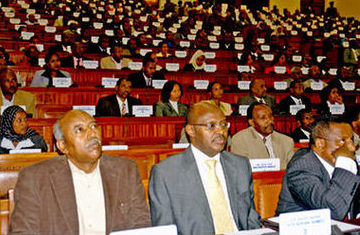
Ethiopian Opposition Confront PM in Parliament


Ethiopia's heated election campaign has spilled onto the floor of parliament, with bitter and at times personal exchanges between Prime Minister Meles Zenawi and opposition leaders. The prime minister was forced onto the defensive on issues from the economy to allegations of political dirty tricks.
read more

US Issues Travel Alert to Ethiopia


The United States is warning Americans to exercise caution when traveling to Ethiopia before and after national elections in May.

The U.S. State Department noted Tuesday that past elections in Ethiopia have turned violent, especially in the days after poll results are announced.

It urged U.S. citizens to avoid political rallies, polling places on election day, and demonstrations.

Read more